The first impression of a book is created not by its content, but by its outward appearance—and this is precisely where colored edges come into play as a design element. Once reserved primarily for Bibles and classics, this feature is now experiencing a modern renaissance. More and more publishers, agencies, and companies are turning to colored edges to make their books stand out. Whether as a striking branding element, a design highlight on the shelf, or a tactile surprise when opening the book—colored edges add character to book design.
It’s not just about aesthetics, but also about strategic differentiation: In a market where visual appeal determines attention, a well-thought-out color scheme creates brand recognition and conveys value. This is made possible by modern printing technology, careful planning, and the interplay of design and precision craftsmanship.
This article explores the possibilities offered by color grading, how to implement it successfully, and the effects that can be achieved with it.
Note: The “colored edges” finishing technique is not currently part of Beltz Grafische Betriebe’s production portfolio. Nevertheless, we would like to provide you with an overview of this unique design technique.
Color Accents: Small Area, Big Impact
What is a color cut?
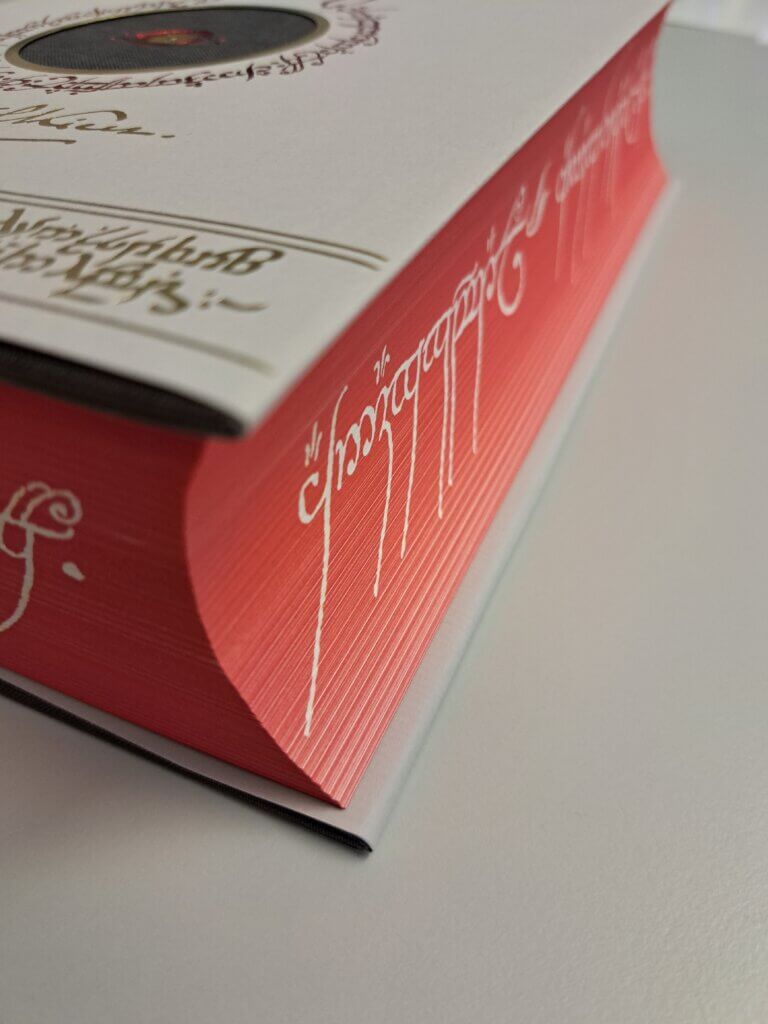
Edge-staining refers to the uniform coloring of the three visible edges of a book: the top, front, and bottom edges. This technique is one of the classic forms of book finishing and is once again being used more frequently today. Unlike metallic effects such as gold or silver edging, colored edges offer a design solution with high brand recognition and great flexibility in color selection.
Colored edges are used in both hardcover and softcover books. They serve not only as a design accent but also as a functional element of a well-thought-out design. The colored edges echo the color palette of the cover, create contrasts, or deliberately introduce breaks. This results in a cohesive and harmonious overall look.
Why Color-Edged Books Are Trending Right Now
Edge-staining is not just a simple design detail. It gives books character and makes them stand out visually from their surroundings. In brick-and-mortar stores, it draws attention on the shelf; online, it increases visual recognition. Especially in high-quality series or special editions, it underscores the design signature of a publisher or company.
Color-edged pages are also gaining importance in corporate publishing. They can be precisely matched to brand colors and reinforce the visual identity. Thanks to their clean, minimalist design, they look modern without being trendy—and at the same time offer a way to deliberately set a book’s design apart from the norm.
Design Meets Craftsmanship: The Path to the Perfect Color Cut
Technical Requirements and Implementation
A precisely executed color edge-cutting process requires more than just choosing the right color. The combined effect of the material, machine operation, and experience is crucial for a good result. To ensure that the color is applied cleanly to the cut edges, the book block must be precisely folded and pressed. Even the slightest irregularities in the trim would become visible later on. That is why the process begins with careful planning well in advance.
The process involves several steps in which the book is treated while it is out of its cover. The color is applied using special techniques and then set so that it neither rubs off nor fades. Here, too, the details matter. The drying time, the paper’s texture, and the pigments used play a decisive role in determining the final result.
What colors and effects are available
In principle, any solid color can be produced; strong contrasts or corporate colors are often chosen. Matte shades, custom colors, and pastel variations are also possible. To achieve a particularly high-quality look, effects such as color gradients, multicolored cuts, or metallic pigments can also be used. This adds additional design layers that set the product apart from others.
In addition to the color itself, the surface also plays a role. Depending on the type of paper and printing technique, the color edge appears either deep and velvety or glossy and striking. It is important that the color and design form a unified whole. Only then does the color edge reveal its full effect and become part of the design, rather than merely an accessory.
When Design Reflects Attitude: Color-Edged Books as a Trademark
A successful example of the creative power of colored edges is the special edition of *The Lord of the Rings*, produced by Beltz Grafische Betriebe in Bad Langensalza. The striking red edges echo elements of the cover and give the entire edition a strong visual presence. This finishing touch is not merely a design detail but part of a well-thought-out concept that underscores the high standards of both content and production. You can find more information about this project in our case study on the colored edge for *The Lord of the Rings*.
Projects like these demonstrate how effectively edge-cutting techniques can be used when design and technology are harmonized. Colored edges offer the opportunity to make products distinctive and, in doing so, convey messages. In mass production, they can create continuity; in special editions, they can make a clear statement. For brands and institutions, this means visibility and brand recognition through visual language.
This effect can be specifically leveraged, particularly in the context of corporate publishing. When color tones from a company’s brand identity are applied to the book’s edge, a cohesive overall look is created. This also offers bookstores and publishers that focus on custom editions an effective way to stand out. Anyone looking for inspiration for their next book title will find numerous examples of high-quality editions—including those specifically featuring colored edges—in the Beltz bookstore’s selection.
Consulting That Thinks Ahead: How to Make Your Color-Cutting Project a Success
Anyone planning a color-edged book should begin coordinating with the printer well in advance. For the result to be impressive, the design, material, and technical execution must be precisely coordinated. The choice of paper affects not only the color effect but also the paper’s absorbency and, consequently, the evenness of the ink application. The production process also plays a role—for example, in determining whether the cover is applied before or after the cut.
Another aspect concerns the print data. Color-cut areas are not defined in the traditional layout but are created as a separate processing step. Expert advice helps avoid potential sources of error and fully exploit the design’s potential. Factors such as ink coverage, edge sharpness, and lightfastness should be taken into account, as should logistical considerations, such as drying time or protection during shipping.

If you’re planning a book project that involves colored edges, we recommend working closely with a provider that specializes in this technique. Beltz Grafischen Betriebe in Bad Langensalza does not offer this service itself. However, we’re happy to advise you if you have questions about implementing high-quality book finishes or are looking for a suitable partner. If you’d like to get a concrete idea of the technical capabilities at our facility, you’ll find more information in our overview of services.
Would you like to plan and implement your project with us? Let’s discuss the possibilities in a no-obligation initial consultation. Contact us now.