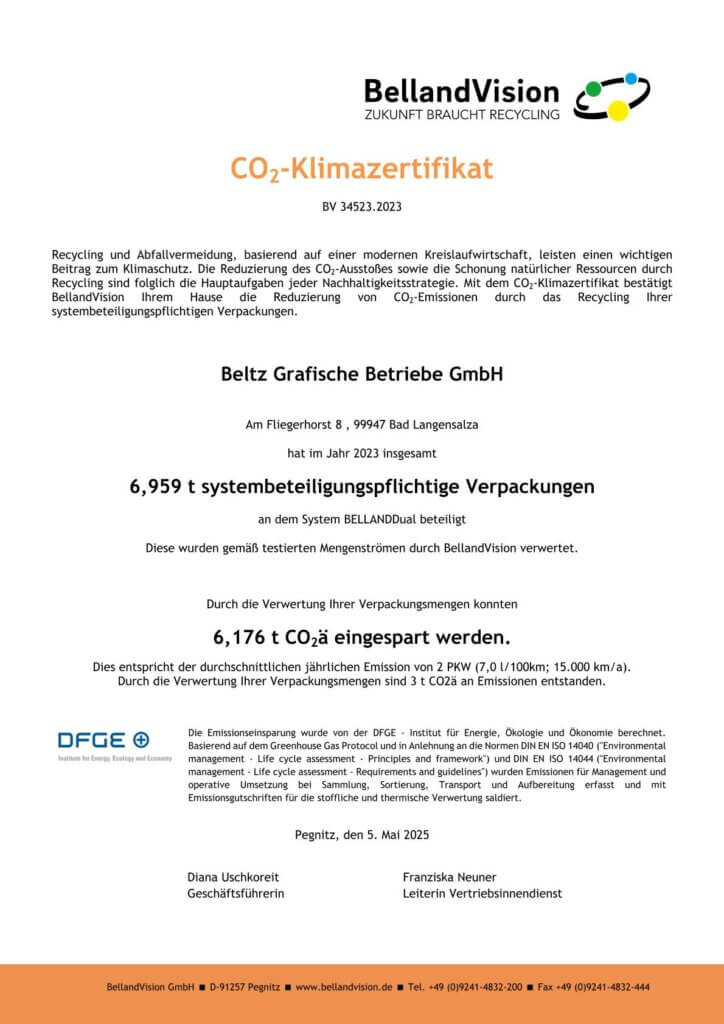
Resource conservation, recycling, and CO₂ reduction—for us at Beltz Grafische Betriebe in Bad Langensalza, these aren’t just buzzwords, but practices we live by. We’re all the more pleased that our commitment to packaging recycling has now been officially recognized: BellandVision’s CO₂ Climate Certificate confirms that, in 2023, we were able to save over 6 metric tons of CO₂ equivalents by recycling our sales packaging.
Participation in BellandVision’s dual system makes it possible to properly collect, sort, and recycle retail packaging—a key component of a functioning circular economy. The CO₂ climate certificate proves, in black and white, that recycling can make a measurable contribution to reducing CO₂ emissions.
A key component of the certification is the so-called CO₂ä unit. It allows for a comparison of the climate impact of various greenhouse gases—and thus provides insight into the actual environmental footprint. This is based on a scientifically sound calculation by the DFGE—Institute for Energy, Ecology, and Economics—aligned with the international Greenhouse Gas Protocol and applicable ISO standards.
In the next section, you’ll learn what this savings means in concrete terms—and why it shouldn’t be taken for granted.
Responsible Packaging and Our Path to CO₂ Climate Certification
Packaging is essential to the printing and shipping process—but it also comes with a responsibility. At Beltz, we take this responsibility seriously. That’s why we’re constantly working to optimize our packaging materials: using less material, improving recyclability, and using more sustainable materials.
Participation in the BELLANDDual dual system is a key component of this effort. It ensures that our packaging is properly collected, sorted, and recycled. The goal: as little waste and as much recycling as possible.
Our CO₂ climate certificate proves that this approach works: In 2023, we introduced nearly seven metric tons of packaging material into the system—which was subsequently recycled. This resulted in a reduction of over six metric tons of CO₂.
This figure represents not only the amount of emissions avoided—but also our commitment to viewing packaging not as a necessary evil, but as a flexible component of our sustainability strategy. Because one thing is clear to us: Sustainability doesn’t begin with the final product—it begins with every single step leading up to it.
What else does sustainability look like at Beltz Grafische Betriebe in Bad Langensalza? You can find more information here.
CO₂ Savings in Numbers: An Article That Makes a Difference
The CO₂ Climate Certificate for 2023 clearly demonstrates how much of an impact a consistent recycling strategy can have on a company’s environmental footprint. By participating in the BELLANDDual dual system, we at Beltz were able to save more than six metric tons of CO₂ equivalents—which is equivalent to the annual CO₂ emissions of two average gasoline-powered passenger cars driven 15,000 km. This figure brings into sharp focus the impact that sustainable action can have.
What exactly are CO₂ equivalents?
Not all greenhouse gases have the same effect. CO₂ equivalents (CO₂e for short) summarize the climate impact of various gases—such as methane or nitrous oxide—in a comparable measure. The basis for this is the so-called Greenhouse Gas Protocol, an internationally recognized framework for reporting greenhouse gas emissions.
How exactly are the savings calculated?
The CO₂ reductions at Beltz are the result of several measures:
- Reduced use of materials: We avoid unnecessary packaging and opt for more efficient solutions.
- Recyclable materials: Our packaging is easier to sort and recycle.
- Sustainable Mobility: Our passenger car fleet has been and continues to be upgraded with electric vehicles.
- Short transport distances: Recycling domestically significantly reduces transport emissions.
- Purchasing Green Electricity: Since 2020, the entire Beltz Group has been purchasing green electricity.
- Participation in the BELLANDDual System: Our Contribution to a Functioning Circular Economy System in Germany.
All of these factors mean that what might be considered waste actually becomes a real contribution to climate protection—properly documented and independently certified.
Sustainable Printing: Our Journey Continues
For us, the CO₂ climate certificate is not a reason to rest on our laurels—but rather an incentive to keep moving forward. After all, sustainable business practices are not a one-time project, but a long-term process. That’s why we at Beltz are constantly working to make our processes even more resource-efficient. In addition to carefully selecting packaging, this includes using efficient machinery, keeping transport distances short, and choosing sustainable materials at every stage of production.
At the same time, we are closely monitoring new scientific findings and developments in the field of carbon footprint assessment. The update of emission factors by the DFGE clearly shows that only those who regularly review and optimize their processes can remain on track toward environmental sustainability in the long term. For us, one thing is certain: recycling, energy efficiency, and the circular economy are inextricably linked to our corporate philosophy.
Are you looking for a partner for sustainable book production?

Then you’ve come to the right place. Let’s set new standards together—for resource-efficient printing solutions that deliver real added value.
👉 Contact us now